Horizon 2020 — SESAR
Modelling and assessing the role of air transport in an integrated, intermodal transport system
Overview
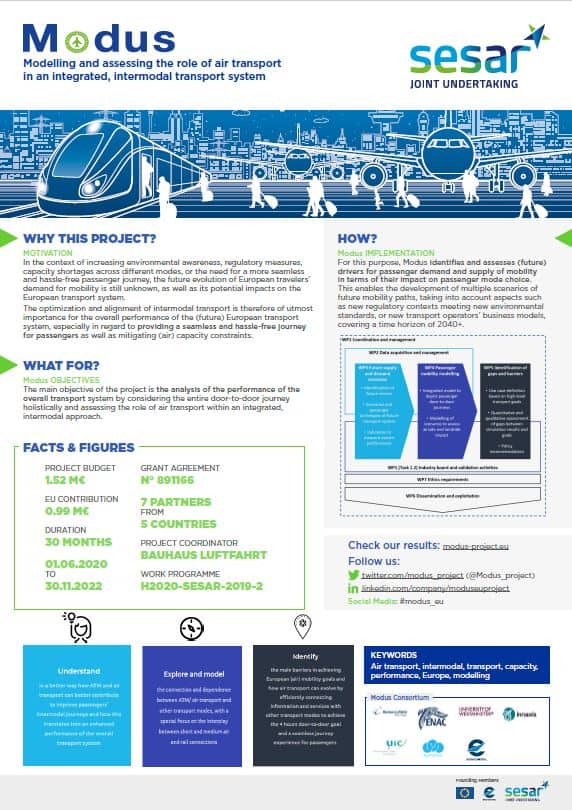
In the context of increasing environmental awareness, regulatory measures, capacity shortages across different modes, or the need for a more seamless and hassle-free passenger journey, the future evolution of European travellers’ demand for mobility is still unknown, as well as its potential impacts on the European transport system. The optimization and alignment of intermodal transport is therefore of utmost importance for the overall performance of the (future) European transport system, especially in regard to providing a seamless and hassle-free journey for passengers as well as mitigating (air) capacity constraints. The main objective of the project is the analysis of the performance of the overall transport system by considering the entire door-to-door journey holistically and assessing the role of air transport within an integrated, intermodal approach. For this purpose, Modus identifies and assesses (future) drivers for passenger demand and supply of mobility in terms of their impact on passenger mode choice. This enables the development of multiple scenarios of future mobility paths, taking into account aspects such as new regulatory contexts meeting new environmental standards, or new transport operators’ business models, covering a time horizon of 2040+.
Facts and figures
- Acronym
- Modus
- Project budget
- 1.52 m€
- EU contribution
- 0.99 m€
- Duration
- 30 months
- Start
- 1 June 2020
- End
- 30 November 2022
- Partners
- 7 partners from 5 countries
- Coordinator
- Bauhaus Luftfahrt
- Work programme
- H2020-SESAR-2019-2
- Grant agreement
- 891166
Project objectives
- 01Understand — in a better way how ATM and air transport can better contribute to improve passengers’ intermodal journeys and how this translates into an enhanced performance of the overall transport system.
- 02Explore and model — the connection and dependence between ATM/air transport and other transport modes, with a special focus on the interplay between short and medium air and rail connections.
- 03Identify — the main barriers in achieving European (air) mobility goals and how air transport can evolve by efficiently connecting information and services with other transport modes to achieve the 4 hours door-to-door goal and a seamless journey experience for passengers.
Project structure
Implementation approach
WP3 will focus on the future supply and demand scenarios. It will identify the drivers for future demand and supply and develop a modal choice model which will be used by the development of scenarios activities. WP3 will then identify which indicators need to be monitored and developed to capture the particularities of the connectivity of passengers in a multimodal environment. The generated demand and supply flows in WP3 will feed the mobility models implemented in WP4. First an interface between these flows and individual passenger itineraries will be created. This will also transform the information from the scenarios into specific input for the models. Two mobility models will complement each other on the analysis: a passenger mobility model and a flight-centric network model. These models will be based on state-of-the-art tools previously developed by members of the consortium and will provide detailed flight and passenger metrics in the full door-to-door context. The runs of these tactical models carried out in WP4 will feed the quantitative and qualitative analysis carried out in WP5 which will be devoted to the identification of gaps and barriers and of the definition of use cases. Finally, all these activities will be supported by close interaction with the Industry Board and validation activities managed from WP1.

Publications
Project deliverables
| WP | Deliverable | Deliverable name | Lead partner | Delivery | Dissemination |
|---|---|---|---|---|---|
| WP2 | D2.2 | Database structure | INX | M21 | |
| WP3 | D3.1 | Modal choice analysis and expert assessment | ENAC | M8 | |
| WP3 | D3.2 | Demand and supply scenarios and performance indicators | BHL | M13 | |
| WP4 | D4.1 | Interface to modal choice model: methodology | INX | M12 | |
| WP4 | D4.2 | Mobility models description | UoW | M20 | |
| WP5 | D5.1 | Definition of use cases | BHL | M13 | |
| WP5 | D5.2 | Report on overall final project results | BHL | M22 | |
| WP6 | D6.2 | Final dissemination report | BHL | M30 |
Papers and presentations
News & Events
- 21 April 2023Press release end of Modus project
- 21 December 2022Save the date: Modus final dissemination event, it’s time for multimodality!
- 05 December 2022Modus attended the World Passenger Festival, INAIR conference and TRA during November 2022
- 22 September 2022An interview with Jörg Ostwald: How to reach true multimodality within Europe - an air+rail love story?
- 19 September 2022An interview with Oana Savu: How to reach true multimodality within Europe - an air+rail love story?
- 22 July 2022An interview with Marc Guigon: How to reach true multimodality within Europe - an air+rail love story?
- 21 July 2022Save the Date: 25 October 2022, Paris, UIC HQ, Modus Project Final Results Conference
- 19 July 2022An interview with Christian Steyer: How to reach true multimodality within Europe - an air + rail love story?
- 17 May 2022Modus European project presented at the European Parliament in Brussels
- 02 March 2022The second Modus workshop was held on 14th February 2022
- 19 January 2022Registration 2nd Online Workshop Modus
- 14 January 2022Second online Modus workshop, save the date 14 February 2022!
- 16 December 2021Are you curious about the progress made since our first Modus Workshop in January 2021?
- 16 December 2021Discover our Deliverable 3.2 ‘Demand and supply scenarios and performance indicators’
- 10 December 2021European Modus project at SESAR Innovation Days 2021
- 20 October 2021Deliverable ’Definition of use cases’ is published
- 27 September 2021Download the first deliverable of WP4 of the Modus project
- 25 June 2021New deliverable now available! Modus D3.1 Modal choice analysis and expert assessment for download ⚠️
- 23 June 2021Customer Experience Management Platform (CEMP) workshop held online on 21 June
- 21 June 2021Modus at Agency Research Team (ART) workshop on passenger-centred mobility
- 05 February 2021The Future of Multimodal Transport: Horizon 2040 First Modus workshop held successfully online on 19 January
- 14 December 2020Modus Workshop “The future of multimodal transport: horizon 2040” Save the date! 19 January 2021
- 09 December 2020Modus at the SESAR Innovation Days 2020 (7-10.12.2020) Join us 10.12.2020
- 16 November 2020Modus: Better understanding and assessing the role of air transport in an intermodal transport system
- 16 November 2020Official launch of the European Project MODUS (modelling and assessing the role of air transport in an integrated, intermodal transport system) on 2 June 2020
Consortium
Seven partners from five countries. Bauhaus Luftfahrt coordinates the project. UIC leads dissemination and exploitation. Bauhaus Luftfahrt. Interdisciplinary research institution funded by Airbus Group, Industrieanlagen-Betriebsgesellschaft (IABG), Liebherr-Aerospace and MTU Aero Engines, and the Bavarian Ministry of Economic Affairs, Regional Development and Energy. An internationally oriented think tank, founded in November 2005 and based on the Ludwig Bölkow Campus in Taufkirchen near Munich since 2015. École nationale de l’aviation civile. Public institution under the French Ministry of Transport. It trains executives and main players of civil aviation and researches air transport. Based in Toulouse, it is one of the leading universities devoted to the aviation industry. University of Westminster. The planning and transport research team has worked on transport research, consultancy and teaching for over 40 years, with a focus on door-to-door passenger mobility, choice, and air traffic management performance. Innaxis. Private research institution studying large-scale socio-technical systems such as energy and transport, using data science, mathematical modelling, nonlinear systems, predictive analytics and computational simulation. UIC. Worldwide organisation for international cooperation among railways and the promotion of rail transport. Founded in 1922, it gathers members on all five continents, including rail operators and infrastructure managers. Skymantics Europe. Technical consulting firm in information technology for aviation and transportation, including travel planning, routing and multimodal connectivity based on open geospatial data. EUROCONTROL. Intergovernmental organisation with 41 member states, committed to a Single European Sky. It employs more than 1,900 professionals across four European countries.
Partners
- Bauhaus LuftfahrtBauhaus Luftfahrt
- École nationale de l'aviation civileÉcole nationale de l'aviation civile
- University of WestminsterUniversity of Westminster
- InnaxisInnaxis
- Union Internationale des Chemins de ferUnion Internationale des Chemins de fer
- Skymantics EuropeSkymantics Europe
- EUROCONTROLEUROCONTROL